Health & Fitness
Neubie Nashville Athlete Performance: How I Use NeuFit With WWE Drew McIntyre to Protect a Career Built on Car Crashes
Neubie Nashville: How I Use NeuFit With Drew McIntyre to Protect a Career Built on Car Crashes
When people think about professional wrestling, they see entertainment.
What they don’t see are the car crashes.
Every match is a collision sport.
Every bump is controlled chaos.
And over a two-decade career, those impacts don’t just beat up joints — they reprogram the nervous system.
That’s where my work with Drew comes in, and why Neubie Nashville plays a role in keeping his body usable, resilient, and durable for the long haul.
The Hidden Cost of a Long Collision Career
In a sport like wrestling, injuries aren’t always dramatic.
They’re cumulative.
Over years:
- The nervous system learns to protect
- Muscles shut down without obvious pain
- Other muscles take over to keep the job done
- Compensation becomes the default strategy
The problem is that compensation works… until it doesn’t.
A muscle that stays “off” long enough doesn’t just lose strength — it loses timing, coordination, and contribution. The body finds another way, and that workaround becomes the seed for future injury.
This is how careers quietly end.
Not from one big incident — but from small neurological debts compounding over time.
Why Strength Alone Isn’t Enough
Drew is strong.
Exceptionally strong.
But strength without neuromuscular integrity is a liability.
You can load patterns that aren’t clean.
You can reinforce compensation.
You can become powerful in the wrong places.
That’s why our work doesn’t start with lifting.
It starts with restoring usable control.
How We Approach Neubie Nashville With Drew
The Neubie, developed by NeuFit, is not a magic fix. It’s a diagnostic and training amplifier.
When paired with proper coaching, it allows me to:
- Identify muscles that aren’t contributing
- Expose compensation patterns instantly
- Re-educate movement without excessive load
- Restore strength at end ranges where injuries live
But the key is how it’s integrated.
CARS: Re-Establishing Joint Communication
Every session begins with Controlled Articular Rotations (CARS).
Not as a warm-up.
As an assessment.
CARS tell me:
- Where motion is missing
- Where control breaks down
- Where the nervous system is guarding
- Which joints are borrowing motion from others
In a collision athlete like Drew, CARS often reveal joints that look mobile but lack true ownership — especially at end range.
That’s a dangerous place to live.
Isometrics: Teaching the Body to Stay
Once we identify weak or unstable ranges, we use isometrics to teach the nervous system that those positions are safe.
Isometrics:
- Build strength without momentum
- Increase joint confidence
- Reduce protective tone
- Improve neural drive to underactive tissue
They’re especially important for athletes who’ve spent years bracing through impact.
The nervous system doesn’t trust motion until it feels control.
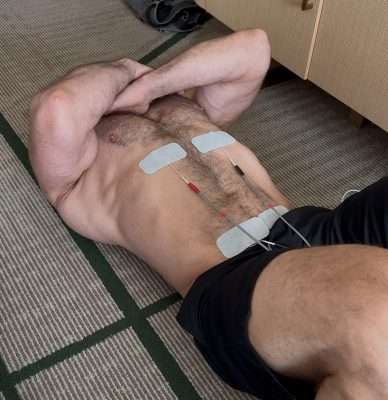
This is where Neubie Nashville Athlete Performance becomes a force multiplier.
We use the Neubie during:
- End-range joint positions
- Controlled prehab movements
- Isometric holds
- Slow, intentional transitions
The stimulation does two critical things:
- It increases awareness of what’s actually firing
- It helps dormant muscles re-enter the conversation
Instead of guessing whether a muscle is working, we know.
And more importantly — Drew knows.
That feedback loop accelerates re-learning in a way traditional methods can’t.
End-Range Prehab: Where Careers Are Protected
Most injuries don’t happen in mid-range.
They happen at the edges.
We intentionally train:
- Hip rotation at end range
- Shoulder rotation under control
- Spine segments that tend to lock up
- Positions that mirrors match demands
The Neubie allows us to load these ranges without excessive joint stress, while still creating meaningful neurological demand.
That’s critical for longevity.
Why This Matters Over a 20+ Year Career
After decades of impacts, the nervous system becomes conservative.
It limits motion.
It shuts things down.
It prioritizes survival over performance.
If you ignore that reality and just keep loading strength, you’re gambling with time.
Our approach with Neubie Nashville is about:
- Preserving movement options
- Maintaining joint integrity
- Reducing compensatory strain
- Keeping strength usable — not just impressive
This isn’t rehab.
It’s career maintenance.
Neubie Nashville Is Not a Shortcut — It’s a Tool
The Neubie doesn’t replace:
- Coaching
- Assessment
- Experience
- Decision-making
It enhances them.
Without a system, it’s just stimulation.
With a system, it becomes precision.
That’s the difference.
Who This Approach Is For
This Neubie Nashville model applies to:
- Collision athletes
- Lifters with long training histories
- People with “mystery” aches that keep moving
- Anyone whose body feels strong but unreliable
If muscles are off, the system breaks down.
If the system breaks down, injury follows.
Final Thoughts
Drew’s longevity isn’t accidental.
It’s the result of respecting:
- The nervous system
- Joint integrity
- End-range control
- Strategic prehab
Neubie Nashville is one layer of that strategy — not the whole plan, but a powerful one when used correctly.
📍 Iron House Strength & Conditioning – Nashville, TN
👉 [Book a session]