Health & Fitness
Hip Pain – How We Restored Hip & Lower-Body Function for an Advanced Lifter | Nashville Neubie
Hip Pain No More: How We Expanded Zack’s Lower-Body Training Options Using the Neubie
A Case Study in Mobility, Control, and Intelligent Progression
When Zack first reached out to me for a Neubie session, he wasn’t broken.
He was an advanced lifter.
He was still training.
He was still making progress toward his goals.
But he was running into a ceiling.
That ceiling wasn’t strength.
It wasn’t motivation.
It was optionality.
Zack’s biggest frustration was the shrinking list of lower-body exercises he could train hard without compensation, irritation, or feeling “off” afterward. When movement options narrow, performance eventually follows—and that’s exactly where he was headed.
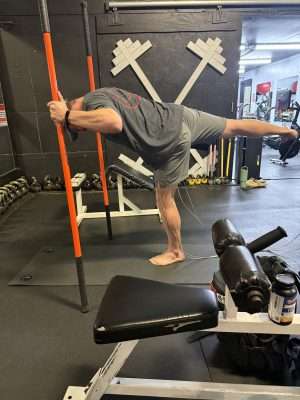
This is where the Neubie and a structured mobility-first assessment came into play.
Session One: Establishing the Baseline
The first Neubie session isn’t about chasing fatigue or pain relief.
It’s about clarity.
We started by looking at:
- Zack’s current usable range of motion
- How his hips moved relative to his pelvis
- How his feet interacted with the ground
- Where control was missing, not just range
Very quickly, two things stood out.
1. A Hiked Hip and a Tight Quadratus Lumborum (QL)
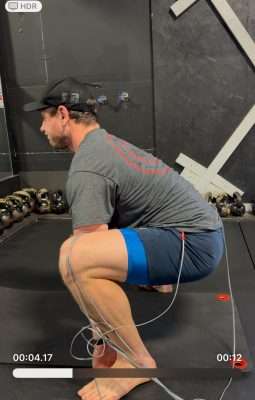
Zack presented with one hip sitting higher than the other. This is often a sign of a dominant or shortened quadratus lumborum, commonly referred to as the QL.
The QL is a deep muscle that runs from the top of the pelvis (iliac crest) to the lower ribs and lumbar spine. Its job is to help stabilize the spine, assist with side-bending, and control pelvic position during gait and loaded movement.
When the QL becomes chronically tight or overactive:
- The pelvis can become asymmetrical
- One hip may appear “hiked”
- Hip range of motion on that side often becomes limited
- Squats, hinging, and single-leg work start to feel uneven
This wasn’t a strength issue.
It was a positioning and control issue.
2. Loss of Hip Internal Rotation (More on the Left)
The second major finding was limited hip internal rotation, especially on Zack’s left side.
Hip internal rotation is critical for:
- Squatting depth and symmetry
- Efficient gait mechanics
- Deceleration and force absorption
- Long-term hip and knee health
When hip internal rotation fades, the body has to steal motion from somewhere else—usually the low back, SI joint, or knee. Over time, this leads to:
- Compensatory movement patterns
- Decreased exercise tolerance
- A feeling of being “stuck” at the bottom of lifts
- Increased joint stress without realizing it
Zack didn’t lack effort.
He lacked usable hip space and control.
3. Poor Big Toe Control and Foot Stability
The final piece was his foot.
Zack had very little active control of his big toe and limited stability through the first ray of the foot. This matters more than most lifters realize.
The big toe plays a massive role in:
- Force transfer from the ground
- Hip and glute activation
- Balance and stability in single-leg tasks
- Maintaining proper knee tracking
If the big toe can’t anchor and control pressure, the chain above it suffers. The hips never get a stable platform to work from.
Why the Neubie Was the Right Tool
This is where the Neubie separates itself from traditional approaches.
The Neubie, developed by NeuFit, uses direct current stimulation to communicate directly with the nervous system. Instead of just strengthening muscles, it helps re-educate movement patterns.
For Zack, this meant:
- Improving neuromuscular communication at the hip
- Restoring control before loading
- Identifying which muscles were overworking and which weren’t contributing
- Training range of motion with feedback, not guesswork
We weren’t trying to “loosen” him up randomly.
We were restoring control inside the ranges he already had, then expanding them safely.
What the Next 8 Weeks Typically Look Like
Every client progresses at their own rate, but a typical 8-week arc for someone like Zack looks like this:
Weeks 1–2: Awareness and Control
- Mapping current hip and foot control
- Neubie-assisted movements to improve internal rotation
- Reducing QL dominance by improving pelvic awareness
- Teaching Zack how to feel what’s working and what isn’t
Weeks 3–4: Expanding Usable Range
- Gradually increasing active hip internal rotation
- Improving foot stability and big toe engagement
- Integrating low-load strength work inside new ranges
- Fewer compensations during lower-body lifts
Weeks 5–6: Strengthening the New Ranges
- Loading movements Zack previously avoided
- Improved symmetry in squats and hinging
- Better balance and control in unilateral work
- Less post-training irritation
Weeks 7–8: Integration Into Training
- Reintroducing more complex lower-body exercises
- Increased confidence under load
- A larger menu of pain-free training options
- Movement that feels intentional instead of forced
The goal isn’t perfection.
The goal is capacity.
The Importance of Homework
Neubie sessions create change—but homework keeps it.
Zack was given specific mobility and control drills tailored to:
- His hip internal rotation deficits
- His QL dominance
- His foot and big toe control
This isn’t random stretching. It’s targeted work designed to:
- Reinforce what we train in session
- Prevent regression between visits
- Build ownership over his movement
Progress doesn’t come from one session a week.
It comes from consistent, intelligent inputs.
My Coaching Philosophy With the Neubie
The Neubie isn’t magic on its own.
What makes it powerful is combining it with:
- Individual assessment
- Strategic mobility
- Exercises you can do well
- Gradual progression from that point forward
We don’t force ranges.
We earn them.
We find what you own, train it, and then expand from there.
Final Thoughts
Zack didn’t come to me because he was weak or injured.
He came because he wanted more options, better longevity, and smarter progress.
That’s what this process is about.
If you’re an experienced lifter who feels boxed in by your lower body—or you’re tired of avoiding movements you should be able to do—this approach may be exactly what you need.
If you’re in the Nashville area and curious about Neubie sessions or individualized mobility work, reach out.
We’ll assess where you are, map where you need to go, and build a plan that actually fits your body.
Book your session with me here