
Health & Fitness
Microdosing GLP-3: How Two Decades of Bodybuilding Broke My Hunger Signals—and How I Fixed It
Microdosing GLP-3: How Two Decades of Bodybuilding Broke My Hunger Signals—and How I Fixed It
Microdosing GLP-3: How Two Decades of Bodybuilding Broke My Hunger Signals—and How I Fixed It
Competing in bodybuilding for nearly two decades teaches you a lot about discipline, suffering, and execution.
What it doesn’t teach you is how to turn hunger off once the shows are over.
Years of contest prep, aggressive calorie deficits, repeated metabolic downshifts, stimulant use, sleep deprivation, and inflammation leave a mark. Even when the trophies stop and the lifestyle “normalizes,” the physiology doesn’t always follow.
That was my reality.
I wasn’t overeating.
I wasn’t lazy.
I wasn’t undisciplined.
I was just hungry all the time.
And on top of that, I was inflamed and carrying visceral fat that didn’t match my training output, activity level, or food quality. Something was clearly off.
This is the context most people miss when they hear “GLP use.” They assume obesity or lack of control. In my case—and in many former competitors—it was the opposite: a nervous system and metabolism stuck in survival mode.
Two Decades of Dieting Has a Cost
If you’ve never prepped for bodybuilding, here’s what matters:
- Chronic calorie restriction resets hunger signaling
- Leptin and ghrelin signaling gets distorted
- Cortisol stays elevated longer than it should
- Inflammation becomes the baseline
- Hunger becomes loud, persistent, and irrational
You can be eating “enough” on paper and still feel like you’re starving.
That’s where I landed.
Even in modest deficits—deficits that should have been completely manageable—I felt constant hunger. Not cravings. Not boredom eating. True, physiological hunger that never shut off.
That’s not a mindset problem.
That’s biology.
The Inflammation + Visceral Fat Piece
Here’s another uncomfortable truth for former competitors.
You can be lean for years and still accumulate visceral fat later in life if inflammation and stress stay elevated.
Visceral fat isn’t just about calories. It’s tied to:
- Cortisol
- Insulin signaling
- Sleep disruption
- Chronic inflammation
- Nervous system tone
I trained hard. I ate well. But I could feel the difference:
- Midsection tightness
- Poor recovery
- Elevated baseline fatigue
- Hunger driving decisions instead of strategy
I wasn’t trying to get stage-lean again. I wanted metabolic relief and health.
That’s when I explored GLP-based support.
Why Standard GLP Doses Felt Awful
Let me be clear.
The recommended doses were a disaster for me.
Yes, appetite dropped—but everything else dropped with it.
At higher doses I experienced:
- Blood sugar crashes
- Flat, weak training sessions
- Digestive issues
- A general “poisoned” feeling
- Zero desire to eat protein or real food
That might be acceptable if your only goal is rapid scale weight loss.
It’s unacceptable if:
- You care about lean mass
- You train seriously
- You value performance and clarity
- You understand long-term health
I didn’t feel supported. I felt suppressed.
So I stopped—and reassessed.
Microdosing GLP-3 Changed Everything
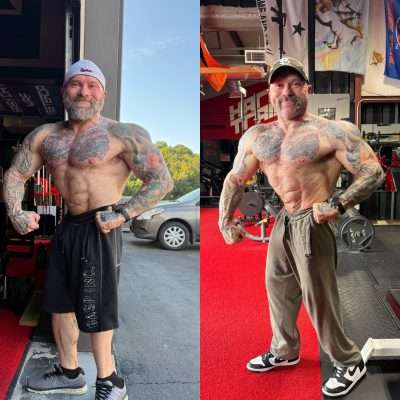
Instead of asking, “How much do I take?”
I asked, “What is the minimum dose that changes the signal?”
That’s where micro-dosing came in.
I stripped the dose down to the lowest effective amount—just enough to:
- Quiet constant hunger
- Reduce food noise
- Lower inflammatory tone
- Stabilize energy
- Preserve training quality
The result wasn’t dramatic.
It was stable.
And stable is exactly what I needed.
Hunger Didn’t Disappear—It Became Rational
This is important.
Micro-dosing did not eliminate hunger.
It normalized it.
Instead of being hungry all day, every day, regardless of intake, hunger became:
- Predictable
- Meal-driven
- Proportional to output
- Manageable in a deficit
That’s a massive shift if you’ve lived in perpetual hunger for years.
Dieting still sucked—but it sucked the right amount.
That allowed me to stay consistent without white-knuckling every decision.
Inflammation Came Down, Fast
This was one of the most noticeable changes.
Within weeks of micro-dosing—paired with:
- Strength training
- Adequate protein
- Structured nutrition
- Reduced stress load
…I felt less “puffy,” less reactive, and more recovered.
Inflammation amplifies hunger.
It amplifies fatigue.
It amplifies poor decisions.
When that background noise dropped, everything got easier to execute.
Training Stayed the Priority
I never stopped training.
That’s non-negotiable.
Throughout the process:
- Strength stayed high
- Muscle mass was preserved
- Output remained consistent
- Recovery improved instead of worsened
This is where most GLP users fail. They stop lifting, lose muscle, and then wonder why they regain weight later.
Micro-dosing allowed me to train like a grown adult athlete, not someone trying to survive a crash diet.
Why This Matters for Former Competitors
If you’ve dieted hard for years—especially in bodybuilding—your hunger signals are likely distorted.
That doesn’t mean you’re broken.
It means your system needs support, not force.
Microdosing GLP-3 wasn’t about shortcuts.
It was about restoring a signal that had been screaming for decades.
Used intelligently, it allowed me to:
- Create a sustainable deficit
- Reduce visceral fat
- Lower inflammation
- Maintain muscle
- Rebuild trust with hunger cues
That’s the real win.
Final Thought
I don’t recommend this casually.
I don’t recommend it blindly.
And I don’t recommend it without structure.
But for former competitors, high-stress adults, and people with long dieting histories, micro-dosing GLP-3 can be a temporary stabilizer, not a lifelong crutch.
It didn’t make fat loss easy.
It made it possible without breaking myself again.
And after twenty years of pushing my body to extremes, that mattered more than anything.
If you are stuck and don’t know what GLP is right for you, reach out and let me see if I can help.