Health & Fitness
BPC-157 Benefits: My Experience Using This Peptide for Inflammation and Recovery
BPC-157 Benefits: My Experience Using This Peptide for Inflammation and Recovery
The use of BPC-157 is a mixed bag for some people, but for me, it helped a lot.
That’s the honest truth I’ve seen from clients using it and my discussions with other coaches.
Some people swear by it. Others say they didn’t notice much. Like many things in health and performance, the answer probably lies somewhere in the middle.
But when your options are limited and your body feels like it’s breaking down, you start paying attention to anything that might help.
What Is BPC-157?
BPC-157 is a synthetic peptide derived from a protective protein found in the stomach. It has gained attention for its potential ability to reduce inflammation, support tendon and ligament healing, improve digestion, and enhance recovery from injuries.
Research on BPC-157 is still limited in humans, but animal studies suggest it may promote tissue repair and improve blood flow to injured areas.
So why would someone consider using BPC-157 in the first place?
A few reasons stand out.
Potential Benefits of BPC-157?
A few reasons stand out.
Research and anecdotal reports suggest BPC-157 may help:
- Reduce inflammation
- Support healing of ligaments and tendons
- Improve gut health and digestion
- Accelerate recovery from soft tissue injuries
What initially drew me toward BPC-157 was the reputation it had built as a massive anti-inflammatory peptide.
And inflammation was exactly the problem I had been fighting for years.
The Injury That Changed Everything
Since 2018, I’ve been dealing with a hip that never fully recovered from a fracture.
On top of that, I tore my gluteus medius, which made an already unstable situation even worse. Add arthritis into the mix and things get complicated quickly.
Every surgeon who has looked at my X-rays has basically said the same thing:
“That hip should probably be replaced.”
To be fair, hip replacement surgery today is far better than it used to be. Outcomes are good, recovery is faster, and many people get their lives back.
But in my situation, things aren’t that simple.
I already have a rod in my femur, and if my hip were replaced, that rod would likely have to be replaced as well.
And let’s not sugarcoat it.
Surgery still sucks.
So I started looking for alternatives.
Enter the Grey World of Peptides
Over my bodybuilding years, I experimented with a handful of peptides.
Some worked.
Some didn’t do much at all.
I’ve used things like IGF-1 LR3, CJC-1295, and DES, and like many people in bodybuilding, I had mixed results. Because of that, I usually stuck to more proven methods.
But when your body stops cooperating, you have to open your mind to new possibilities.
By January of 2023, things had deteriorated enough that I was sent to a spine surgeon.
The hip surgeon wanted to replace my hip.
But first, she told me I should get the spondylolisthesis in my lower back looked at.
At that point, I wasn’t thinking about athletic performance anymore.
I just wanted to walk again without my back feeling like it was about to snap.
Inflammation in my lower body had reached the point where daily movement felt like a battle.
Over time, I noticed something that bothered me more than the pain itself.
I was slowly avoiding living just to avoid the pain.
And that wears on you mentally.
Recovery Is Harder With Osteogenesis Imperfecta
My situation is further complicated by the fact that I have Osteogenesis Imperfecta, a genetic condition also known as brittle bone disease.
When I get injured, recovery takes far longer than normal.
After breaking my femur around the rod while squatting just four weeks out from a bodybuilding show in 2017, it took roughly six months before things felt even remotely normal again.
I’ve also had a limp since I was 15 years old.
That started after a skateboard accident that led to multiple surgeries on my legs. It took six years before I could walk normally again.
Over time, that limp created its own chain reaction of compensations.
Those compensations eventually caught up with me.
This has now been the fourth time in my life that I’ve had to relearn how to walk correctly.
Each time involves fixing imbalances and retraining my nervous system, which often feels like it has a different plan than my brain does.
But for the first time in a while, my body started feeling better.
And BPC-157 was part of that process.
My Experience Using BPC-157
When I started researching BPC-157, one of the better articles I found was written by Ben Greenfield, who did a great job breaking down the peptide and how people were using it.
He recommended a protocol of 250 mcg twice daily for eight weeks.
So that’s where I started.
After about a week, I noticed some improvement, but it wasn’t the dramatic “wow” effect that some people talk about.
So I adjusted the dose.
I increased it to 500 mcg twice daily, and that’s when I started noticing a bigger difference.
My body felt more refreshed.
My legs felt better.
And the constant ache I had grown used to began to ease up.
What I Noticed After Eight Weeks
By the eight-week mark, I’ll be honest—I was getting tired of the injections.
Anyone who has done daily peptide injections understands that feeling.
But by that point, something had clearly shifted.
My joints hurt less.
My range of motion had improved.
And week by week, I felt more capable of moving normally again.
Now, was it all BPC-157?
Probably not.
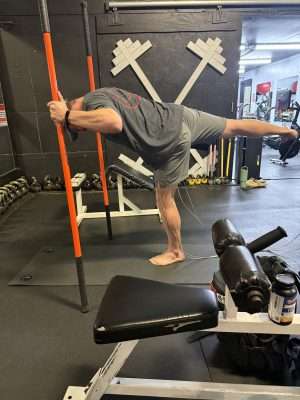
I was also doing physical therapy, training differently, and paying close attention to recovery.
But one thing stood out.
I had never experienced that full-body refreshed feeling the day after using something the way I did with BPC-157.
My Current Protocol
After stopping the daily injections, I noticed some of the tightness and inflammation slowly returning.
So I experimented.
Today my approach is much simpler.
Instead of frequent dosing, I’ll take around 5 mg every two to four weeks depending on how my body feels and how recovery from training is going.
Interestingly, a number of my older clients have adopted a similar strategy.
Several clients over 40 take 5 mg roughly once per month, and many report noticeable improvements in recovery and joint comfort.
An Unexpected Benefit: Gum Health
One of the more surprising things I experienced had nothing to do with joints or muscles.
There is some research suggesting BPC-157 may help with periodontal healing and gum health.
Before taking BPC-157, my gums would bleed almost every time I brushed my teeth.
Because of Osteogenesis Imperfecta, I’ve lost bone in my lower jaw, which makes gum health harder to maintain.
But since starting BPC-157, the bleeding has decreased significantly.
Interestingly, there is research supporting this observation:
https://pubmed.ncbi.nlm.nih.gov/20388954/
While more human research is still needed, the regenerative potential of BPC-157 is something scientists are continuing to explore.
The Bigger Picture
There are many different ways to approach recovery.
Training adjustments.
Mobility work.
Better sleep.
Nutrition.
Stress management.
Sometimes it requires thinking outside the traditional box.
For me, BPC-157 became one of those tools.
It wasn’t a miracle.
But it helped reduce inflammation, improved how my body felt day to day, and allowed me to continue pursuing an active lifestyle.
If you’re someone who trains hard, deals with chronic inflammation, or simply wants to improve recovery as you get older, BPC-157 might be worth exploring.
Like anything in health and performance, it’s not about relying on one single solution.
It’s about finding the combination of strategies that allows your body to keep doing what it was designed to do:
Move, recover, and keep going.
Recovery isn’t just about peptides. Mobility, inflammation management, and training structure all matter. That’s something I work through with clients inside my online coaching program.
FAQ Section
Is BPC-157 safe?
BPC-157 is considered a research peptide, meaning it has not been approved by the FDA for medical use. Most evidence comes from animal studies and anecdotal reports.
What does BPC-157 help with?
Users often report benefits such as reduced inflammation, improved tendon and ligament healing, better digestion, and faster recovery from injuries.
How long does BPC-157 take to work?
Some people report improvements within a few weeks, while others may take longer depending on injury severity and dosage.